
Insight
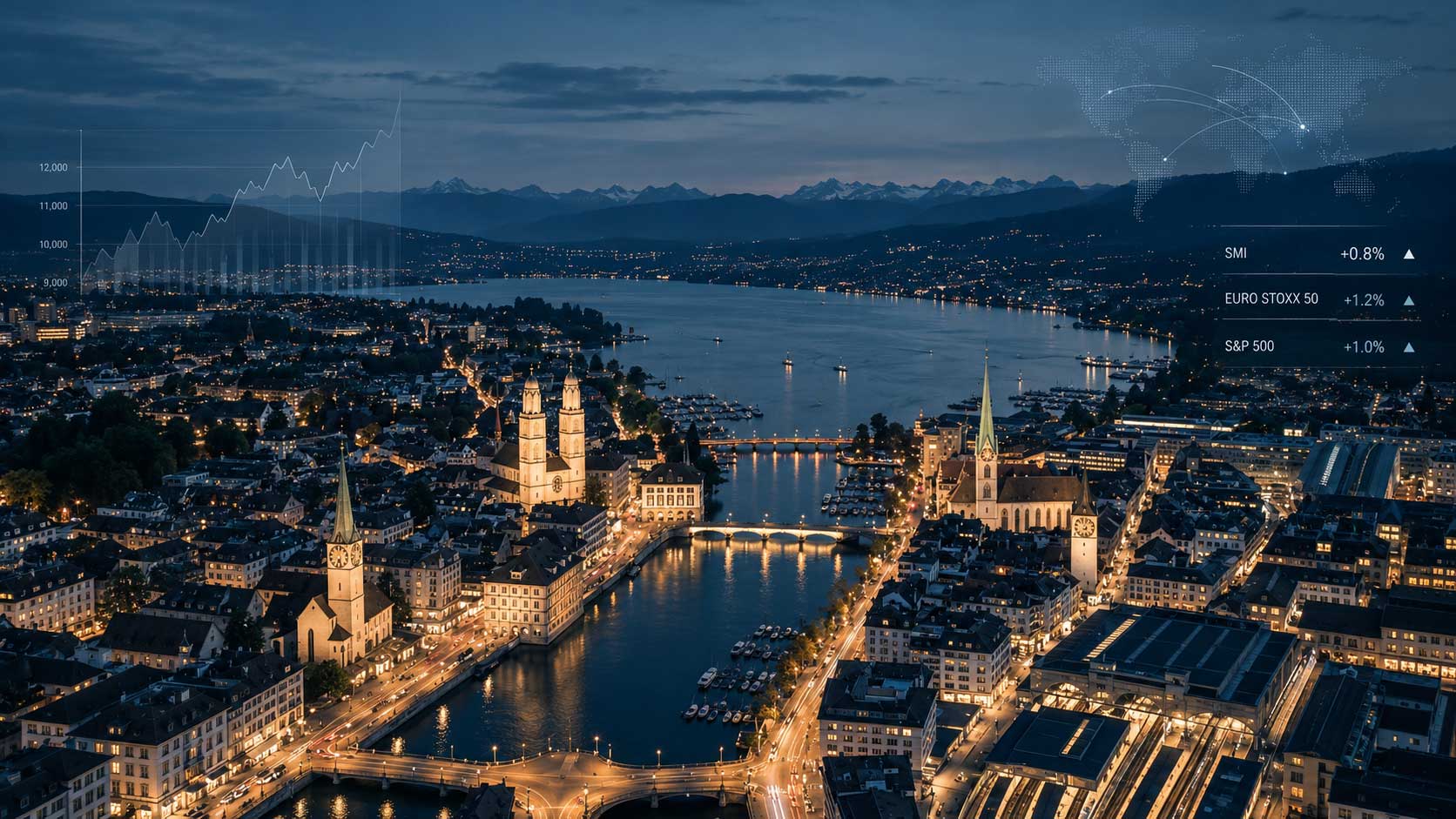
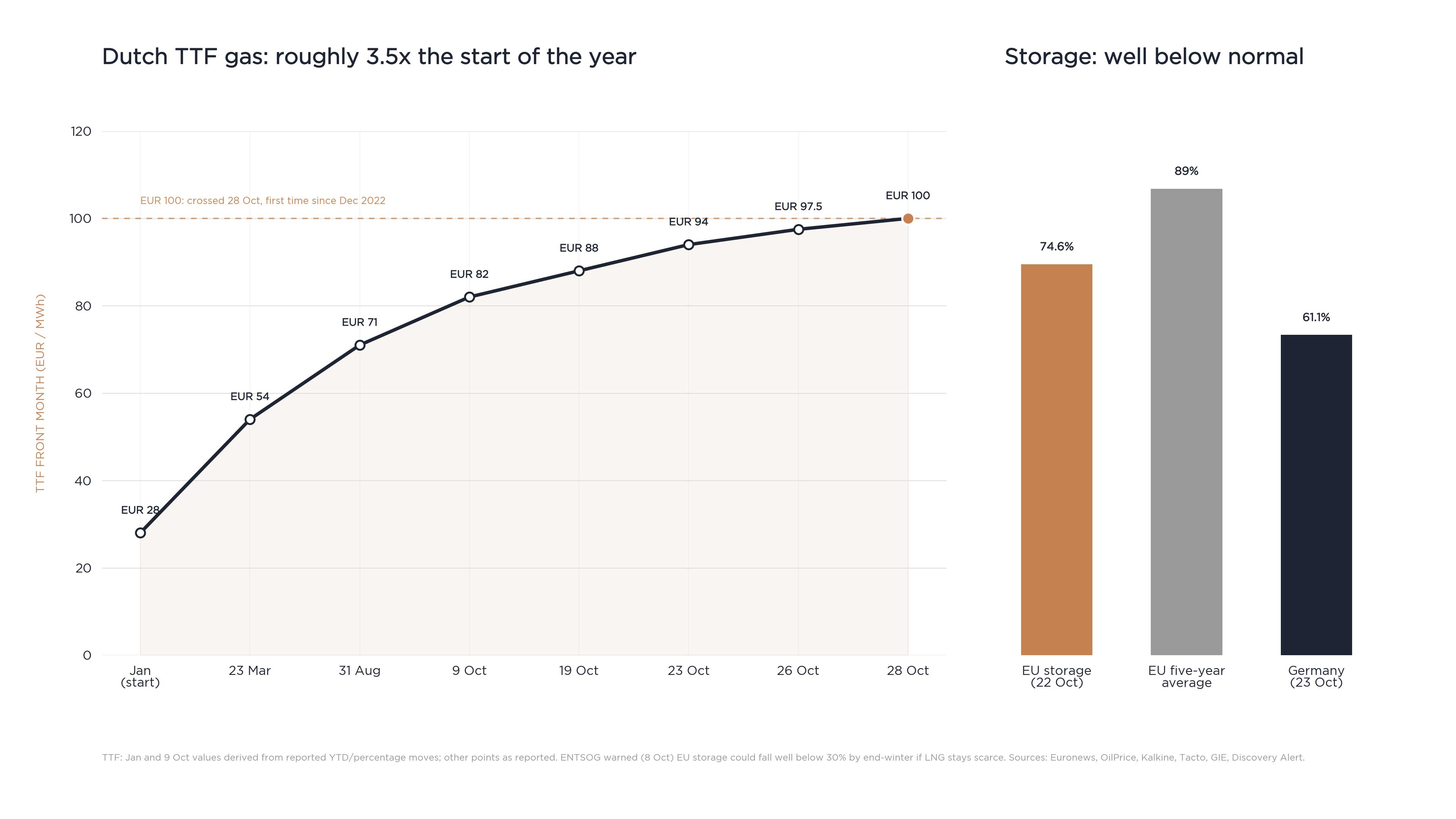
On 28 October, the Dutch TTF benchmark broke above €100 per megawatt-hour for the first time since December 2022 hours after EU Energy Commissioner Dan Jørgensen warned that the bloc faces another energy crisis. EU gas storage stood at 74.6% on 22 October, roughly 15 points below the five-year average, while Brent crude traded between $111 and $115 per barrel. With Qatari LNG flows reduced to a trickle for seven months, the winter is no longer a forecast. It has begun.
Central banks responded with patience rather than panic. The Federal Reserve held at 3.75–4.00% on 28 October in a 10–2 vote, with two members preferring a hike. The ECB which has raised rates twice since June was expected to hold its deposit rate at 2.50% on 29 October. The SNB has kept its policy rate at 0.00% since 24 September, even as Swiss inflation reached 1.0%, its highest since September 2024.
Markets spent October in a narrow range. The STOXX 600 sits near 642, about 2.7% below its early-August level, while the SMI has held its ground and the franc has regained strength against the euro. Gold slipped below $4,000 on 23 October. For Swiss investors, October’s message is clear: Europe’s energy exposure is a real cost, and Switzerland’s stability is a real advantage.
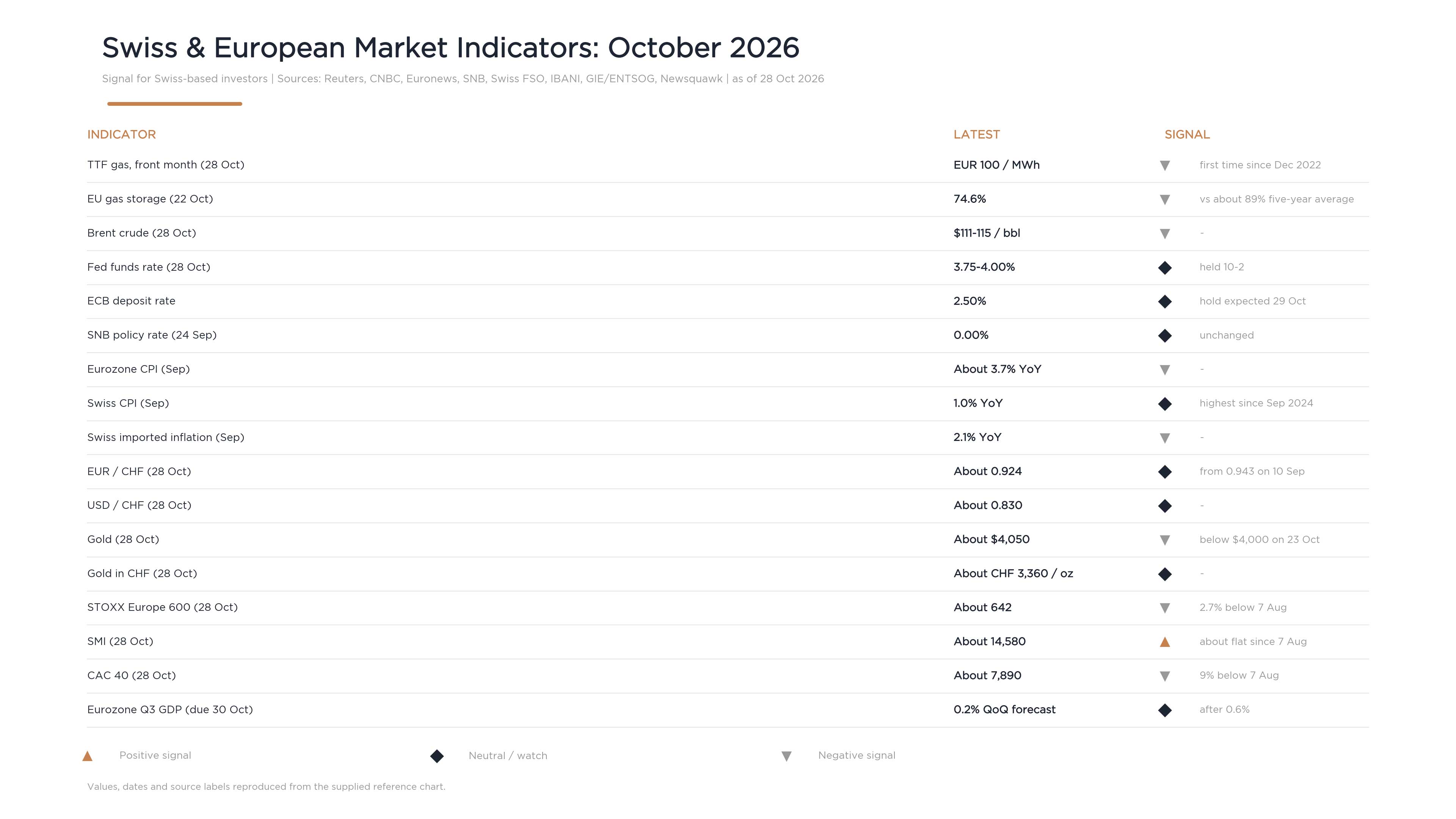
Key Market Indicators at a Glance October 2026
The most important chart in October 2026 is not an interest rate. It is the Dutch TTF gas price. From roughly €28 at the start of the year, TTF climbed to about €54 in March after strikes on Qatar’s Ras Laffan complex, reached the low €70s by the end of August, and finished October at €100 roughly three and a half times where it began.
Why This Matters Beyond Energy
The critical point: Europe cannot create LNG. It can only compete for it, and it is competing with Asia at spot prices above $29 per MMBtu. Until Qatari flows return or Hormuz traffic normalises, storage will be refilled slowly, if at all, during the withdrawal season.
Oil adds to the pressure. Brent traded in a $111–115 range on 28 October after President Trump said further US strikes on Iran remain possible after the US midterm elections, according to RTTNews. Energy Aspects has modelled average day-ahead gas prices near €110 per MWh across November to March if Hormuz traffic fails to normalise and the winter runs cold. That is a scenario, not a forecast but it frames the range of outcomes European industry and households are now planning for.
Three Central Banks, Three Postures
The Fed, the ECB and the SNB all face the same oil-driven inflation shock. October showed how differently they are choosing to respond.
The Fed: A Pause With a Door Left Open
The ECB: Tightened Twice, Now Watching
The ECB raised its deposit rate from 2.00% to 2.25% on 11 June and to 2.50% on 10 September. Ahead of the 29 October meeting, analysts broadly expected a hold: eurozone inflation was running near 3.7%, but energy costs have so far shown limited spillover into underlying prices, and President Lagarde said on 14 October that second-round effects had not yet appeared. Reuters noted that attention is also on French government bonds and on speculation about Lagarde’s future, with a possible early departure to lead the World Economic Forum. Eurozone third-quarter GDP, due on 30 October, is forecast at just 0.2% after 0.6%. The ECB’s next decision follows on 17 December.
The SNB: Steady, Supportive, Data-Dependent
The SNB held its policy rate at 0.00% on 24 September. Chairman Martin Schlegel stressed that the SNB offers no forward guidance, will decide in December on the data, and regards current policy as supportive. That posture has been tested but not broken: Swiss inflation of 1.0% sits comfortably inside the 0–2% price stability range.
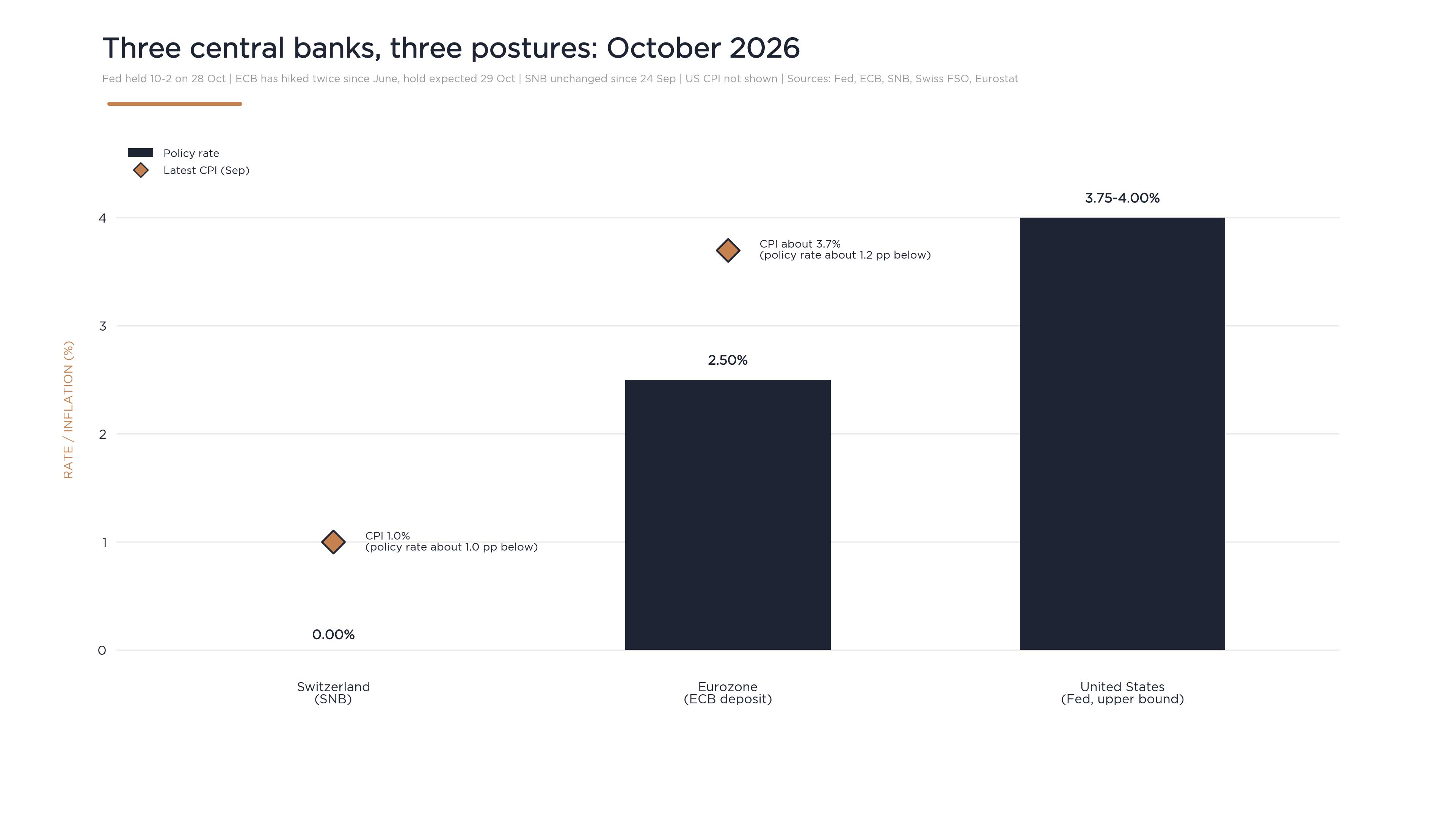
The contrast matters for Swiss portfolios. The SNB is the only one of the three that has not had to tighten — a direct dividend of a lower starting inflation rate and a franc that absorbs part of the import-price shock.
Switzerland: Higher Inflation, Steady Hand, Firmer Franc
Swiss consumer prices rose 1.0% year-on-year in September — up from 0.8% in August, in line with consensus, and the fastest pace since September 2024. The step-up is almost entirely petroleum: inflation excluding petroleum products held near 0.3%, while imported inflation rose to 2.1% as a weaker franc earlier in the autumn amplified higher energy costs.
What to Watch in the Swiss Data
The Franc Regains Ground
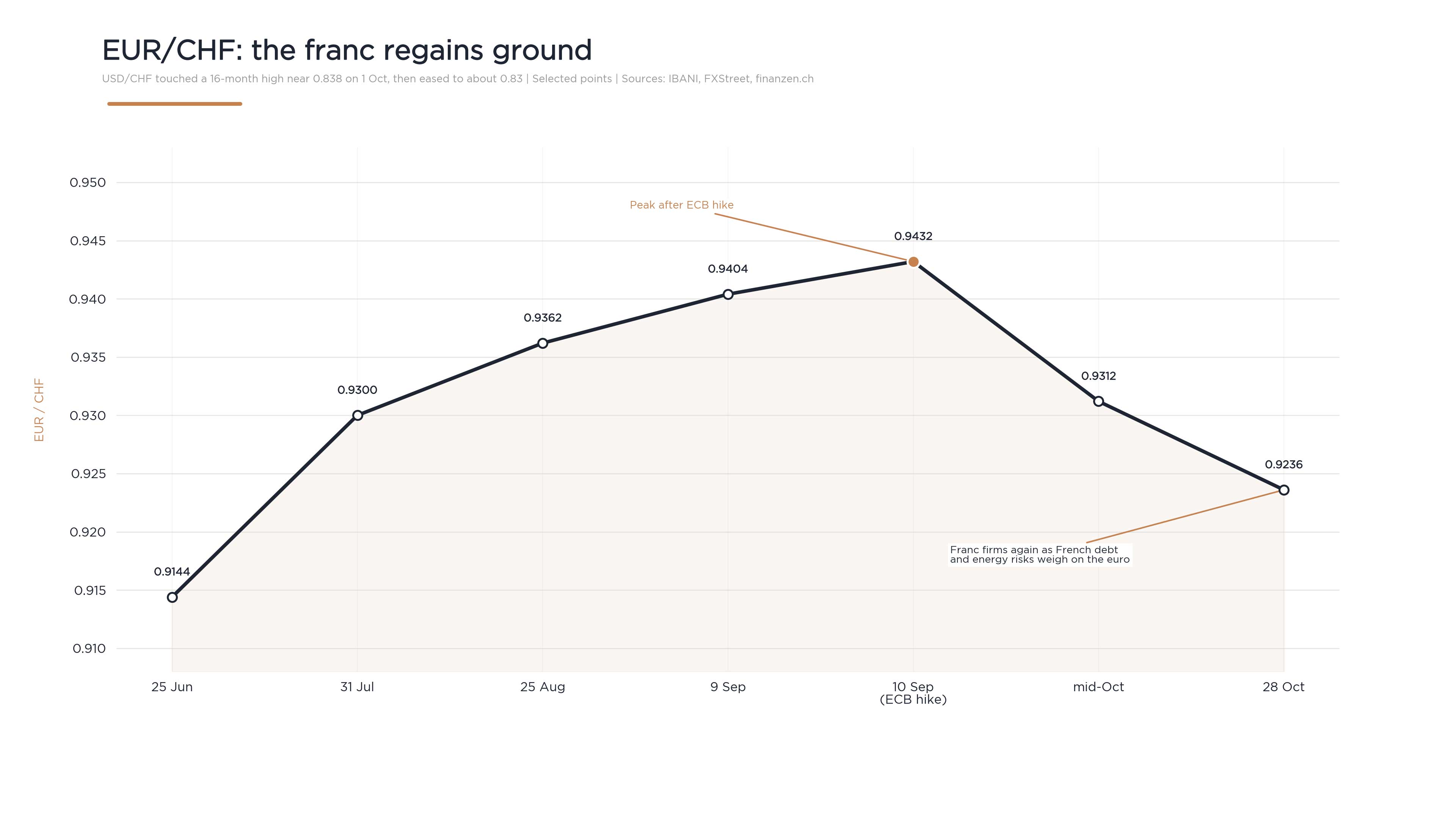
EUR/CHF peaked at 0.9432 on 10 September, the day of the ECB’s hike, and has since slid to about 0.924. IBANI points to French debt concerns weighing on the euro. The franc also strengthened against the dollar from the 16-month low it touched on 1 October, when USD/CHF reached about 0.838; the pair now trades near 0.83. For Swiss-based investors holding unhedged euro assets, that move is a direct drag on returns and a reminder that the currency question is never settled.
European Markets: Earnings Hold the Line, France and Oil Set the Ceiling
The STOXX 600 has traded in a narrow range around 640 since the start of last week, according to Reuters, as political uncertainty in France and rising oil prices offset a steady stream of third-quarter results. Deutsche Bank reported a 2% rise in quarterly profit against expectations of a decline, but the Euro STOXX Banks index still fell about 1% in morning trading on 28 October as investors weighed mixed lender results and exposure to sovereign debt. China-exposed names were hit harder: Kering fell about 16% and Volvo Car about 26% in the 23 October session on weak Chinese demand.
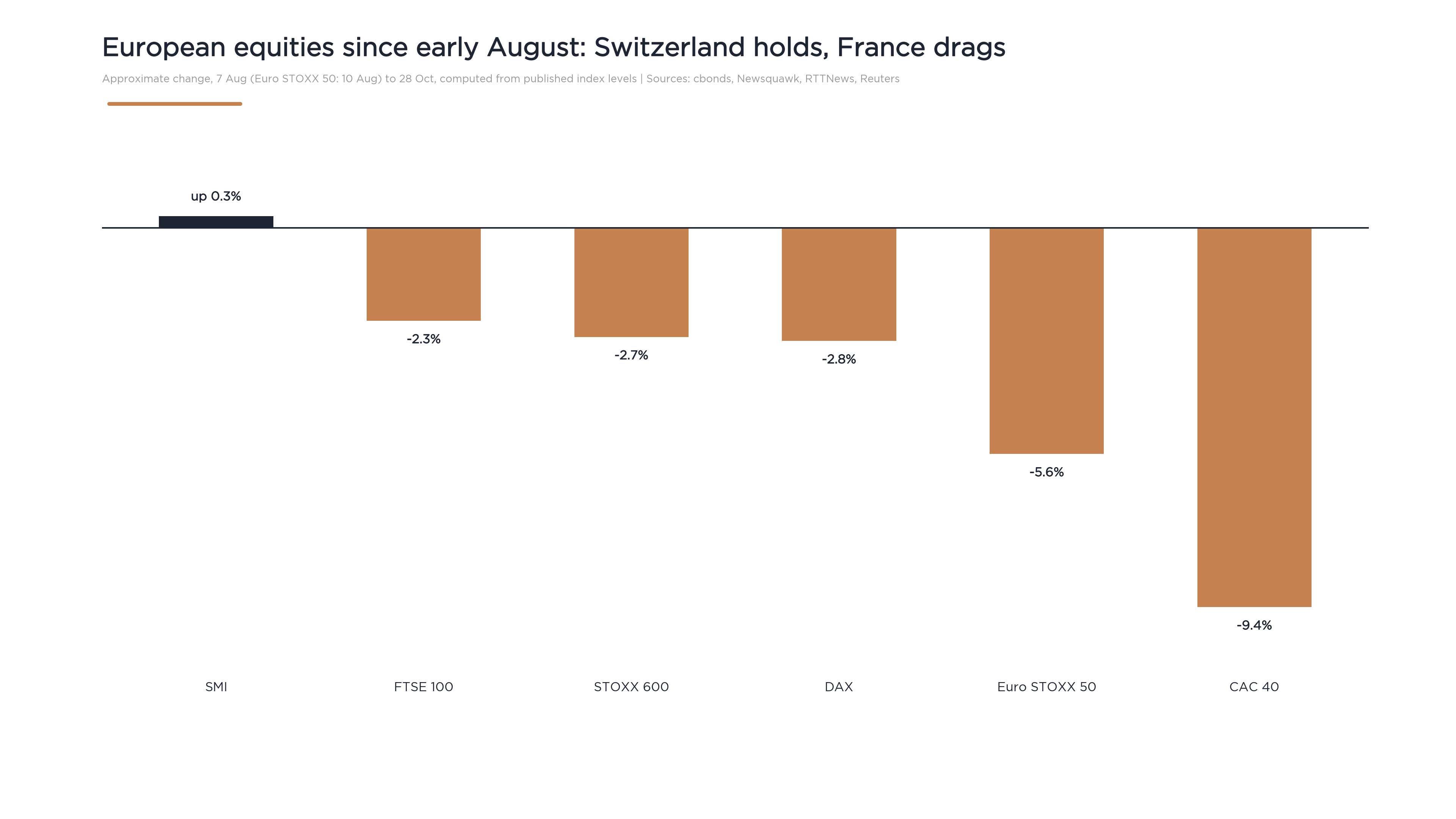
The divergence is the story. Since early August, the SMI is roughly flat while the STOXX 600 is down about 2.7%, the DAX about 2.8% and the CAC 40 about 9.4%. Switzerland’s defensive sector mix and a firm franc have again shown its value in a month driven by energy risk and French politics.
Gold: Below $4,000, Structure Intact
Gold opened October above $4,200, then slid to about $3,998 on 23 October down roughly 4% on the week as the dollar firmed and Treasury yields rebounded. It has since steadied near $4,050, equivalent to roughly CHF 3,360 per ounce. The structural case is unchanged: central bank buying hit a record in the second quarter and US fiscal concerns persist. What has changed is the near-term backdrop, in which energy-driven inflation keeps interest rates higher for longer.
Strategic Framework: Preparing for the Winter
October does not call for a change of strategy. It calls for sharper attention to three exposures Swiss and European investors can influence.
1. Know Your Energy Exposure at Portfolio Level
With TTF at €100 and Brent above $110, energy-intensive industrials, chemicals and transport face higher input costs, while energy producers and infrastructure benefit. Understanding that exposure across the whole portfolio — not just within an energy allocation — is now a practical requirement.
2. Treat the Franc as an Active Position
EUR/CHF has fallen more than 2% from its September peak. Unhedged euro exposure is no longer a passive outcome. A hedging review before the December central bank meetings is basic portfolio governance.
3. Keep Quality and Diversification Where They Have Worked
The SMI’s relative resilience, and resilient earnings at several large European lenders, support maintaining a quality tilt. The pressure points French debt, energy-intensive sectors, China-exposed luxury and autos are specific, not systemic.
4. Hold Gold for the Structure, Not the Month
A sub-$4,000 print is a short-term reaction to rate expectations and a firmer dollar. Investors with a multi-year horizon are holding the structural thesis rather than trading the monthly move.
Dates That Matter
Final Thought
Europe built much of its industrial model on the assumption of reliable, affordable energy. October 2026 is a reminder that the assumption can be interrupted and that the cost of the interruption is paid first by the economies, and the currencies, with the least buffer.
Switzerland’s position is different, not immune. Inflation has risen to 1.0%, the franc has been volatile, and the SNB will face its own December test. But the combination of a central bank that has not needed to tighten, a currency that has regained strength, and an equity market that has held its ground while its neighbours slipped is not an accident. It is the product of structure.
The winter will be decided by storage, supply and diplomacy none of which any investor controls. What investors do control is how prepared their portfolios are for each outcome. That is where October’s work begins.
Market Commentary by AIX Group AG
Disclaimer
This market analysis is produced for information and knowledge purposes only. It does not constitute financial advice, a solicitation, or an offer to buy or sell any financial instrument. The information has been compiled from publicly available sources believed to be reliable; however, AIX Group AG does not guarantee its accuracy or completeness. Readers are advised to seek independent professional advice before making any investment decision. Past performance is not indicative of future results. All investments involve risk, including the possible loss of principal.
References and Sources

Please select “AGREE & CONTINUE” below: By clicking the “AGREE & CONTINUE” button below, you warrant that you acknowledge that you have read and understood the Terms and Conditions and Terms of Use and agree to be bound by their terms.