
Insight

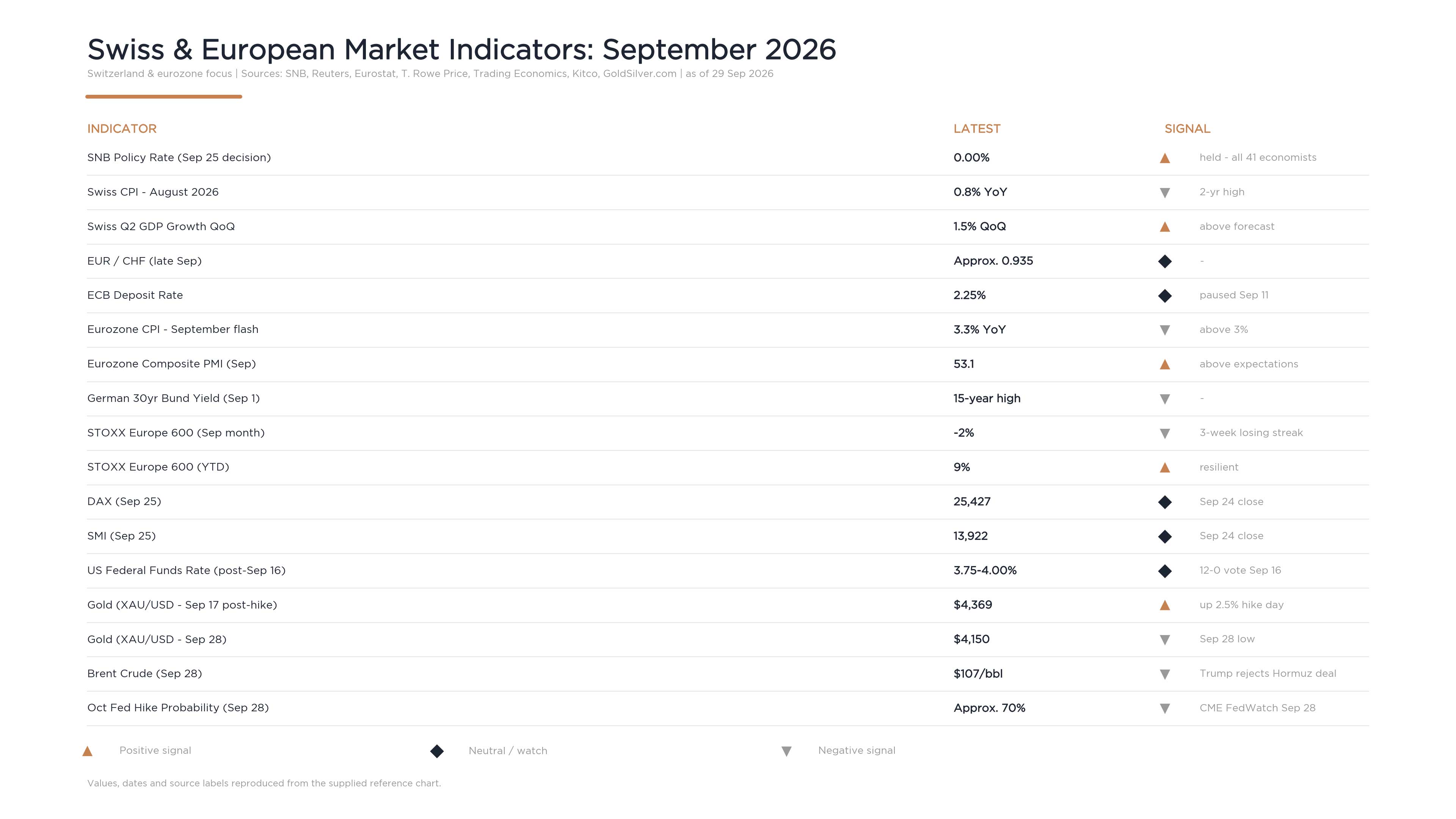
September 2026 is the month the Fed finally acted. On September 16, the Federal Open Market Committee voted 12-0 to raise the federal funds rate by 25 basis points to 3.75-4.00%, the first rate increase since 2023, and a decision that Chair Warsh described as ‘removing a dose of accommodation.’ Markets had priced a 92% probability of the move by decision day, making the hike itself less surprising than what came with it: a dot plot in which 16 of 18 FOMC members projected at least one additional rate hike before year-end, with the median projection landing at 4.1% by December 2026. The message was not just that the Fed had acted, but that the Fed intends to act again.
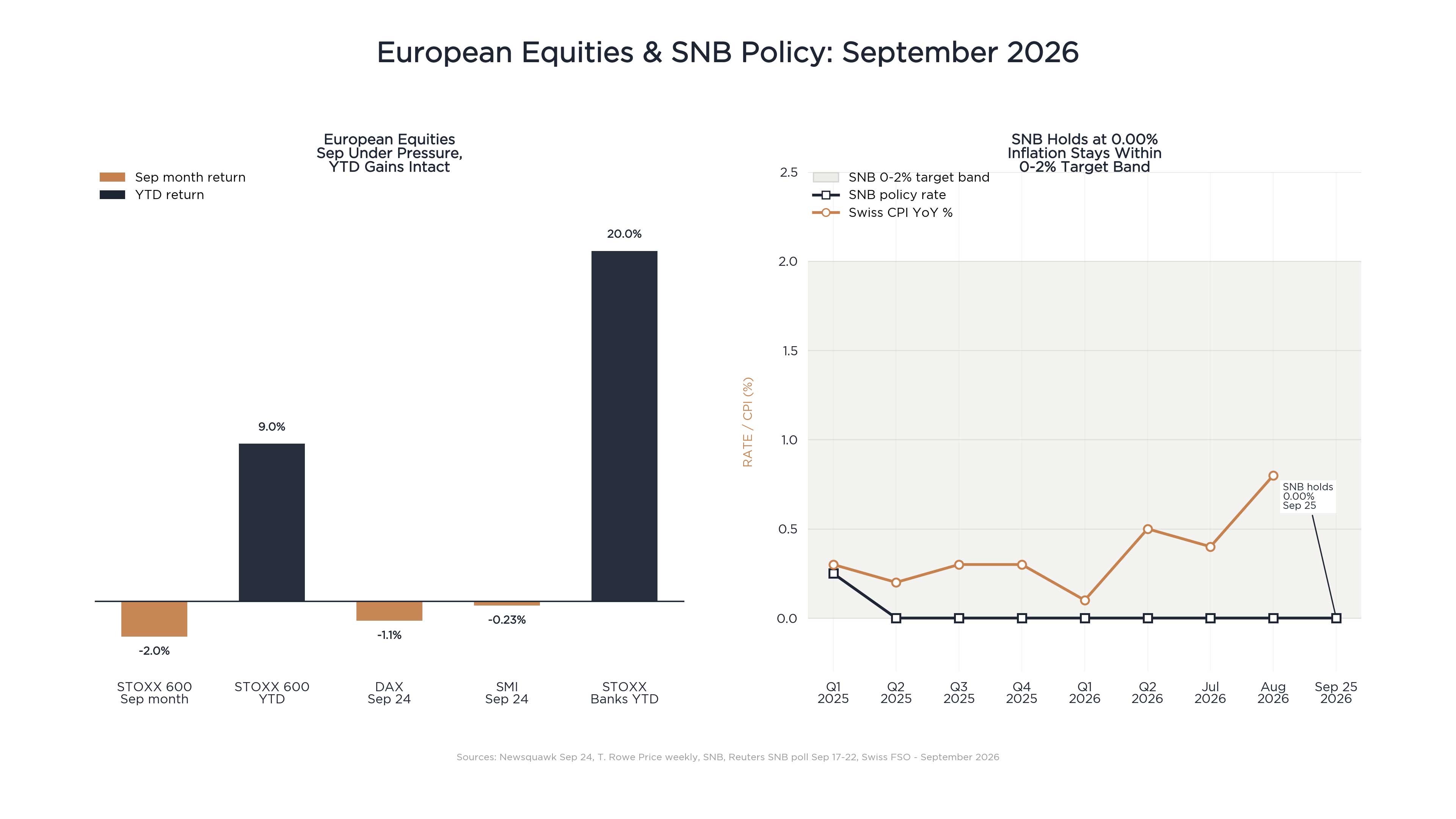
In Switzerland, September brought the calm that the broader market did not enjoy. The SNB held its policy rate at 0.00% on September 25, as all but one of 41 economists in the Reuters poll had forecast. Swiss inflation, while reaching a two-year high of 0.8% in August, remains comfortably within the SNB’s 0-2% target range, and the central bank’s September statement reaffirmed a stable path through 2026 and into 2027. The SNB’s steadiness is not complacency; it is the dividend of disciplined inflation management through the conflict period.
European equities faced their toughest month of the year. The STOXX Europe 600 fell approximately 2% in September, snapping a three-week losing streak only in the final days of the month as oil prices briefly retreated. German 30-year Bund yields hit a 15-year high on September 1. The eurozone composite PMI rose to 53.1 in September, above expectations, but input cost acceleration reinforced concerns about further ECB tightening. And on September 28, President Trump’s rejection of Iran’s latest Hormuz proposal sent Brent above $107/bbl and gold below $4,150, raising the probability of an October Fed hike to over 70%.
September’s title captures the moment precisely: between the hike that has been delivered and the horizon that remains uncertain. For clients, navigating this interval requires both the conviction that the structural case for European and Swiss assets remains intact, and the discipline to understand what the road ahead now genuinely requires.
The September 16 Decision: One Hike, and a Warning of Another
The Federal Reserve’s September 16 decision arrived with the inevitability of a verdict that had been delivered at Jackson Hole and merely formalised in Washington. The 12-0 vote, unanimous where July’s hold had generated three dissents, was a demonstration of institutional cohesion after months of debate. Chair Warsh’s press conference language was precise and measured: the decision was ‘serious and responsible,’ inflation ‘has been too high for too long,’ and the predominant focus is on the price stability side of the dual mandate.
What mattered most was not the hike but the dot plot. The September Summary of Economic Projections revealed a committee that has materially revised its view of the policy path: 16 of 18 members projected at least one further rate increase in 2026, with the median year-end federal funds rate projection at 4.1%. GDP growth for 2026 was revised up to 2.3%; PCE inflation to 3.7% — well above the 2% target. The unemployment rate projection was lowered to 4.1%. The message embedded in these projections is that the US economy is running hotter than the committee anticipated, inflation is not slowing at the pace required, and policy needs to do more work.
Crucially, Warsh rejected a preset path for future rate increases, emphasising that each meeting will be data-dependent. This is relevant for Swiss and European investors: it means the October 27-28 FOMC meeting is a genuinely live decision, not a formality. The August CPI print, due mid-October, is the most consequential single data release between now and that meeting.
The Gold Paradox: Surging on Hike Day, Then Falling
Gold’s September trajectory is instructive and counter-intuitive. On September 17, the day after the hike, gold surged 2.5% to $4,368.91/oz. The explanation lies in market mechanics: Treasury yields, having spiked in anticipation of the decision, corrected sharply post-announcement as investors concluded the hike was delivered cleanly and that the immediate tightening shock was absorbed. Brent crude fell 4.21% on September 17, easing inflation concerns and reducing the case for further immediate tightening. Gold ETFs recorded eight consecutive sessions of inflows through mid-September, with August alone seeing $18 billion of inflows lifting total holdings by 121 tonnes to a record 4,189 tonnes.
Then came September 28. President Trump’s public rejection of Iran’s latest proposal to resume Hormuz negotiations, followed by Brent surging to $107/bbl, triggered an immediate repricing. Gold fell 3% to $4,156/oz, its lowest level since August 5. The oil-inflation-rate hike pipeline reasserted itself: higher crude means higher inflation, which means higher rates, which means a stronger dollar and lower gold. By September 29, gold was trading near 4,100-4,150. The October Fed hike probability had crossed 70%.
Oil and the Hormuz Pipeline: Brent at $107 and Rising Stakes
The Strait of Hormuz conflict has now entered its eighth month, and Brent crude has risen approximately 35% since the MOU was signed on June 30, from $79/bbl to $107/bbl by September 28. The oil market’s response to Trump’s September 28 rejection of Iran’s Hormuz reopening proposal was immediate and severe: Brent jumped above $107, the 10-year Treasury yield climbed back above 5.2%, the 30-year topped 5.3%, and CME FedWatch showed the October hike probability rising from 64.2% to 70.3% in a single session.
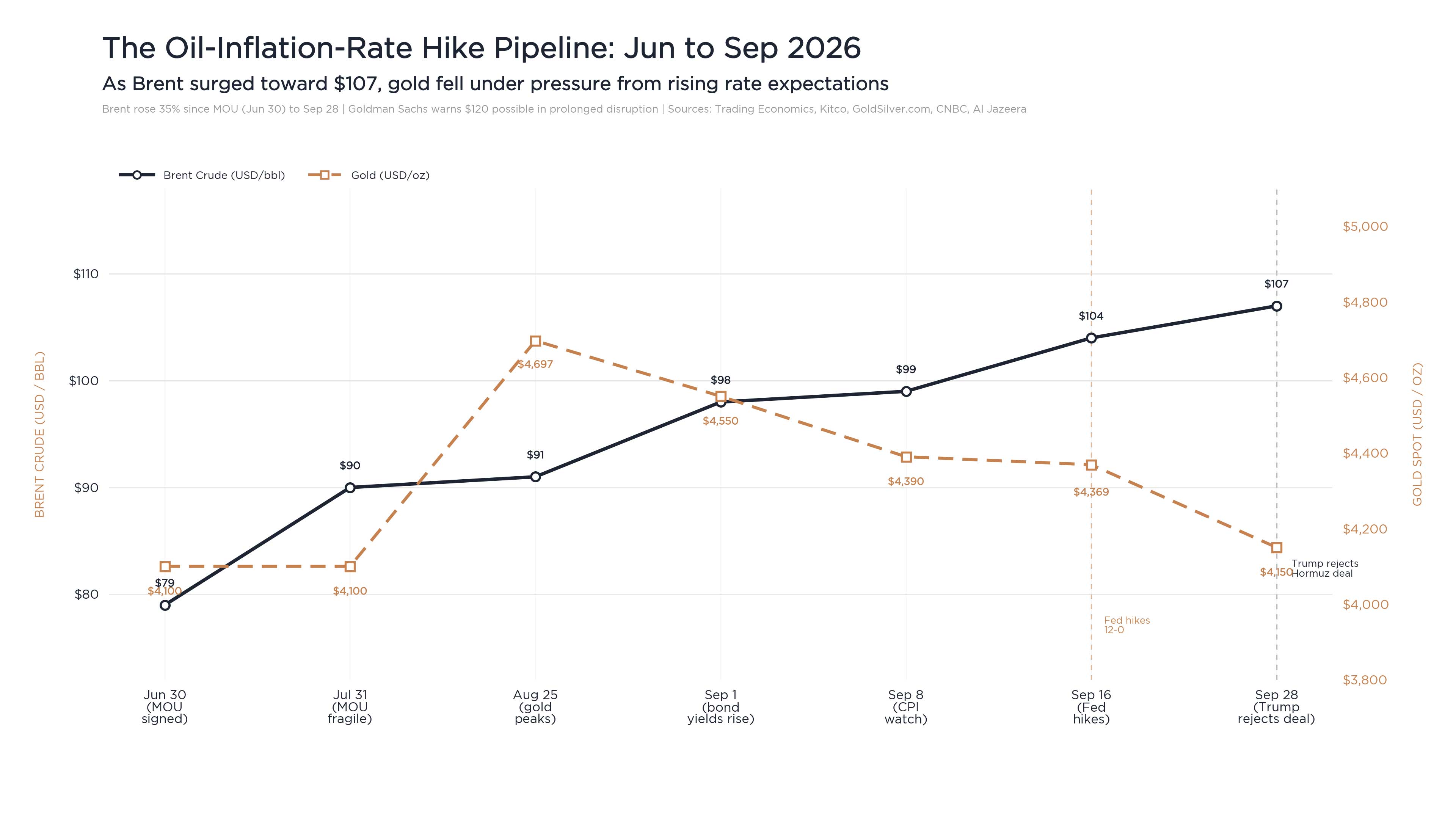
Goldman Sachs has warned that Brent could exceed $120 in a prolonged disruption scenario. For Swiss and European investors, the energy cost transmission is more direct than for US counterparts: eurozone energy inflation reached 14.3% year-on-year in August, and the September flash CPI reading above 3% confirms that inflation pressures are not yet subsiding. The ECB’s September 11 pause was driven by genuine uncertainty about whether the data warranted further tightening September’s oil surge will not make that calculation easier for November.
Switzerland Holds Steady; Europe Tests Its Resilience
The SNB: Stability as a Strategic Asset
The SNB’s September 25 decision to hold at 0.00% was the least surprising event of the month, and arguably the most important for Swiss investors. In a global environment where the Fed has just hiked to 3.75-4.00%, the ECB is at 2.25% and signalling further tightening, and bond markets are experiencing their most volatile period since 2022, Switzerland’s monetary stability is a distinguishing characteristic rather than a passive condition. It is the foundation on which Swiss portfolio construction operates.
The Reuters poll of 41 economists (September 17-22) found near-unanimity: 40 of 41 expected the hold on September 25, and 21 of 25 predicted the rate would remain at 0.00% at year-end 2026. SNB Chairman Martin Schlegel has explicitly cited the ‘undesirable side effects’ of negative rates as a reason the bar for further policy action is high in either direction. The SNB’s inflation trajectory, with Swiss CPI at 0.8% in August, within the 0-2% band, does not provide a compelling case for action, even as the 0.8% reading demands monitoring.
EUR/CHF closed September at approximately 0.935. The double failure at 0.9406 in August remains technically significant, and the SNB’s reaffirmed intervention readiness provides a ceiling. The SNB-ECB rate differential of 2.25 percentage points, the widest in modern history, creates ongoing pressure toward EUR/CHF appreciation, but the pace of that move is constrained by the SNB’s clear signalling. For Swiss investors holding eurozone assets, the currency overlay question is not whether to hedge but how much and at what strikes.
European Equities: Pressure, But Not Breakdown
September was a challenging month for European equities. The STOXX Europe 600 fell approximately 2%, ending a three-week losing streak only in the final days of the month as oil prices briefly retreated. German 30-year Bund yields hit a 15-year high on September 1. The ECB’s Kocher warned publicly that excessively high inflation must not become entrenched. Rising bond yields — Germany’s 30-year above long-term historical norms, France’s 30-year at its highest since 2008 — create a valuation headwind for equities as the discount rate rises.
Yet the YTD picture remains compellingly positive: the STOXX 600 retains a 9% year-to-date gain, the Banks index is up 20%, and the underlying earnings trajectory identified by Goldman Sachs in August, including 14% EPS growth in H1 and 15% forecast for the full year, has not been revised materially. The September PMI composite reading of 53.1, above expectations and driven by improving German and French activity, confirms that the eurozone growth story is not broken. The September weakness is a rate and energy shock repricing, not a fundamental deterioration.
The SMI’s relative outperformance on challenging days, most notably its 0.34% gain on September 1 while the DAX fell 1.1%, continues to demonstrate the defensive quality of Swiss equities within the European complex. For clients with European allocations, a Switzerland tilt within that exposure has been a consistent source of risk-adjusted return improvement through the volatility of 2026.
The Road Ahead: What October and Q4 Will Determine
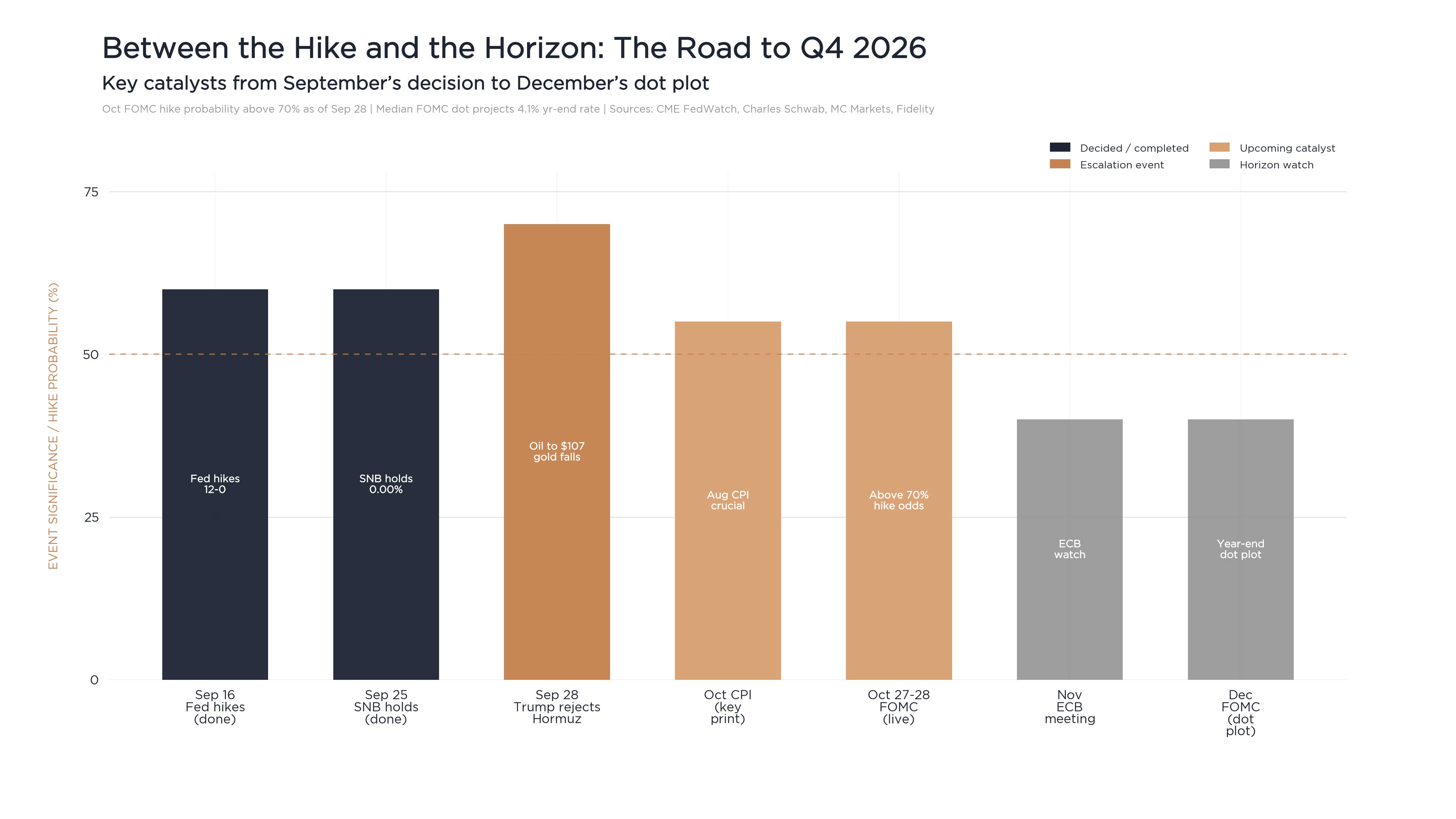
September’s hike resolved one question and raised several more. The Fed acted; but with the dot plot projecting 4.1% by year-end and October hike odds above 70% as of September 28, the immediate question is not whether the Fed is done (it almost certainly is not) but how many more moves remain, and at what pace. The horizon between now and December’s dot plot is the territory clients must navigate.
The Five Catalysts That Define Q4
1. The October CPI Print (due mid-October)
This is the single most important data release between now and year-end. If August CPI comes in at or below 3.0% year-on-year, October hike probability falls sharply and markets reprice toward a pause. If it prints above 3.5%, consistent with continued oil price elevation, the October hike becomes near-certain and December becomes live. For gold, European equities, and the CHF, the October CPI is the fulcrum of Q4.
2. The October 27-28 FOMC Meeting
With 70%+ hike probability priced at month-end, the October meeting is no longer a formality. A second consecutive hike would take rates to 4.00-4.25%, compress valuation multiples for growth assets, put further pressure on gold, and create a meaningful drag on European equities through the dollar channel. A pause, if accompanied by language acknowledging deteriorating global conditions, could trigger a meaningful relief rally across risk assets.
3. The Strait of Hormuz Diplomacy Track
Trump’s September 28 rejection of Iran’s Hormuz proposal is not necessarily a final word. Oman, Qatar, and Saudi Arabia remain engaged as intermediaries, and the economic pressure on both sides of the conflict is mounting. A genuine diplomatic breakthrough — or even credible progress — would push Brent back below $90, reduce October CPI expectations materially, lower Fed hike probabilities, and provide a broad-based relief rally in European and global equities. The Hormuz track remains the most powerful single variable in the global macro equation.
4. The SNB September 25 Statement as a Compass
The SNB’s September statement and Chairman Schlegel’s commentary provide a useful compass for Swiss investors. The SNB is not tightening; it is not easing; it is watching. That posture, stable, vigilant, and ready to intervene in the currency market if needed, is precisely the framework Swiss investors should apply to their own portfolios. Stability is not passivity; it is the foundation from which selective risk-taking makes sense.
5. The ECB November Meeting
The ECB paused on September 11 but ING analysts have noted that a further hike — if data shows a core inflation uptrend — would imply that the ECB sees restrictive policy as necessary, ‘a much bolder move.’ The November meeting, set against a backdrop of 3.3% eurozone CPI and rising energy prices, will be a critical signal for European equity valuations and the EUR/CHF trajectory. For Swiss investors with eurozone equity exposure, the ECB path matters almost as much as the Fed’s.
5. Strategic Positioning: Between the Hike and the Horizon
The title of this month’s report is also its strategic instruction. Between the hike that has been delivered and the horizon that Q4 will reveal, the appropriate posture for Swiss-based investors is one of maintained conviction in structural positions, active currency management, and disciplined patience at a moment when reactive positioning would be costly.
What to Maintain
What to Manage Actively
Final Thought
Between the hike and the horizon. September 2026 sits in that space precisely. The Fed has acted: unanimously, clearly, and with a forward signal that leaves little room for interpretation. The SNB has held: as expected, as warranted, and with a steadiness that is itself a form of policy guidance for Swiss investors. European equities have absorbed a difficult month without surrendering the structural gains of the year. And the Strait of Hormuz remains the wild card that could either extend the pressure of the current environment or, in the event of genuine diplomatic progress, resolve much of it remarkably quickly.
The message from September is one that the entire 2026 series has been building toward: the investors who navigate this environment best are not those who react to each data print or geopolitical headline, but those who maintain conviction in structural positions, manage the risk factors they can control (currency, duration, energy exposure), and exercise patience at a moment when the temptation to act is highest. The hike has been delivered. The horizon will come into focus.
The hike has been delivered. The horizon will come into focus. Between the two, discipline is the only strategy that holds.
Commentary by AIX Group AG
Disclaimer
The above market analysis/information is produced for information and knowledge purposes only under personal capacity, and does not constitute any liability or obligation upon the readers or the firm to take investment decisions. Professional investors only.
References and Sources

Please select “AGREE & CONTINUE” below: By clicking the “AGREE & CONTINUE” button below, you warrant that you acknowledge that you have read and understood the Terms and Conditions and Terms of Use and agree to be bound by their terms.